







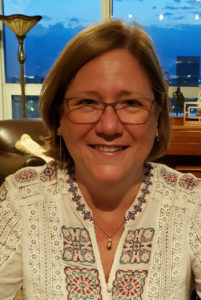
ICSOM Secretary Laura Ross
Photo credit: James T Green
The Musicians of The Cleveland Orchestra and the Cleveland Federation of Musicians, Local 4 AFM hosted this year’s ICSOM Conference on August 20–23 at the Crown Plaza Cleveland at Playhouse Square, beginning with an expanded new delegate orientation session held the evening before the start of the conference on Tuesday evening.
Wednesday began with the traditional roll call of orchestras, introductions of officers and guests, and welcoming remarks from our conference hosts—ICSOM Delegate Charles Paul and Local 4 President Leonard DiCosimo—and The Cleveland Orchestra’s President and CEO André Gremillet. Any conference is special when ICSOM welcomes a new orchestra to its membership, and this year ICSOM welcomed the Toledo Symphony back into the fold, having stepped away from ICSOM upon the formation of ROPA.
Following brief officer reports (in addition to their required written reports), ICSOM President Nicole Jordan (Philadelphia Orchestra) spoke about her efforts to increase ICSOM’s visibility in the industry, and ICSOM Chairperson Keith Carrick (Utah Symphony) addressed the multitude of attacks on labor and funding that affect collective bargaining and our orchestras, urging ICSOM’s members to demand and practice democratic values.
AFM President Tino Gagliardi addressed the conference in the afternoon and spoke about some of the issues he has focused on this past year, such as immigration and cultural exchange issues, coalition building with other entertainment unions, the threat of replacement by AI, and upcoming and ongoing contract negotiations, including for the Integrated Media Agreement.
Delegates had a lively discussion and voted to accept the Hawaii Symphony’s bid to host the 2026 conference from August 19–22, 2026, at the Waikiki Marriott Hotel and Resort. Delegates also approved conference hosting in 2027 by the four orchestras in the New York area (New York Philharmonic, New York City Ballet Orchestra, Metropolitan Opera Orchestra, and the New Jersey Symphony Orchestra). A further bid from the Indianapolis Symphony Orchestra to host the 2028 conference was also accepted.
Cleveland Federation of Musicians Local 4 President Leonard DiCosimo joined his colleague, former executive secretary of the North Shore AFL-CIO Federation of Labor (Cleveland), Harriet Applegate (Local 4), in a discussion of the importance of allying with other labor organizations and how they can help and coordinate messages through social media. This was followed by a discussion between ICSOM, ROPA, RMA and TMA leadership, and brief remarks from AFM Vice-President from Canada, Allistair Elliot. That evening, Local 4 hosted the ICSOM Mixer, complete with entertainment by the Athena String Quartet, at the Hofbrau Haus.
Thursday morning began with internal meetings between delegates and the Governing Board with the first of two town halls, followed by a luncheon with delegates and their members-at-large. After lunch the conference began with reports about the AFM Strike Fund, ICSOM communications, and a presentation about ranked voting (an idea under consideration after some previous conferences devolved into multiple rounds of balloting.)
This was followed by presentations from Symphonic Services Division (SSD) as Laurence Hofmann discussed the ICSOM wage chart and Debbie Newmark talked about the upcoming Integration Media Agreement (IMA) negotiations with the Employers Media Association (EMA) utilized by 126 orchestras, the handful of alternative individual IMA agreements, the approval responsibilities orchestra committees should follow in the IMA, and a new project approval agreement designed to facilitate discussions between management and the committee. SSD Director Rochelle Skolnick gave a presentation about the new AFM Code of Conduct, discussed how due process has been eroded by the Trump administration, and the new #NotMe app that is intended to be used to report discrimination and harassment to the AFM.
Nominations closed and all officers were elected by acclamation: Keith Carrick as chairperson, Mike Muszynski (Indianapolis Symphony Orchestra) as editor, Jack Latta (Grand Rapids Symphony) as member-at-large, and new board members Rob Schumitzky (Pacific Symphony) as treasurer—replacing Peter de Boor (Kennedy Center Opera House Orchestra)—and Thomas Burge (Charlotte Symphony)—replacing Kim Tichenor (Louisville Orchestra)—as member-at-large.
Orchestrate Inclusion’s Jessica Schmidt’s presentation “Tools For Difficult Conversations” included time for small group discussion about a time they engaged in a challenging conversation and offered ideas to put into practice when preparing for such conversations. That evening many delegates and guests purchased tickets to hear The Cleveland Orchestra (TCO) perform Chopin and Rachmaninoff at Severance Hall followed by a small reception backstage with a number of TCO musicians after the concert.
Following adoption of a resolution to be presented to Senator Sherrod Brown on Saturday, Friday began with a presentation by Robert Levine (Milwaukee Symphony Orchestra) and ICSOM Counsel Kevin Case. The orchestra had just completed negotiations that included significant changes to their audition and tenure provisions. (Levine attended negotiations as president of Local 8 as he retired August 31 from the orchestra as principal violist.) Such changes included viewing auditions and tenure together as a single hiring process, preserving candidate anonymity as much as possible during playing rounds, giving probationary musicians multiple opportunities for feedback, and implementing a background check process for audition winners. The default tenure period also was shortened to one year.
A panel discussion regarding individual agreements was moderated by Kevin Case; panelists included Elizabeth Rowe (Boston Symphony, retired), Nicole Jordan (Philadelphia Orchestra), and Caitlyn Valovick-Moore (Utah Symphony). This panel was intended to encourage beginning conversations in orchestras regarding replacing individually-negotiated contract terms with collectively bargained terms for principals and other titled players. That would not mean the elimination of overscale or other favorable terms, but would instead have those terms bargained instead of leaving it up to individuals to negotiate for themselves. While admitting it is challenging to begin thinking about this topic, each member shared difficulties they faced when bargaining overscale as a wind doubler, a librarian, and a principal wind player. Their experiences were awful but unfortunately not surprising. They were lied to, another was expected to work for free before their job actually began, and management refused to negotiate for extended periods of time. The lack of transparency in overscales, the liberal leave allowances that put an undue burden on the rest of those musicians’ sections, and receiving allowances that may violate the CBA (which is illegal) lead to morale problems in orchestras. Panelists and attendees agreed there are strong opinions on both sides of this issue because people are looking at how it affects them personally. However, many also understood this discussion was an attempt to address equitable and fair treatment for the entire orchestra, not just the stars, because it should be the entire orchestra that is the star.
Following this thought-provoking panel discussion, Kevin Case’s presentation “Trump 2.0 – Implications for ICSOM Orchestras and All of Us” pointed out that we now live in a fundamentally different country than we did seven months ago. Issues that directly affect our orchestras, both in organizing and bargain as well as our orchestras’ economic wellbeing and support, were covered. They included the gutting of the National Labor Relations Board (NLRB) and Federal Mediation and Conciliation Services (FMCS), the destruction of the National Endowment for the Arts (NEA) and National Endowment for the Humanities (NEH), the war on Diversity, Equity and Inclusion (DEI), immigration issues that will affect soloists/conductors/orchestra musicians’ visas, climate change, tariffs, inflation, artificial intelligence (AI), etc. – all will impact our orchestras. Without an NLRB quorum, bad management behavior could go unchecked; without FMCS, there will be no free mediators for negotiations; the impact of cuts to the NEA and NEH have broader implications than just our individual orchestras as they also supply county and state funding allocators; DEI has led to completely rewritten rules that appear to deny protections for those they were written for; climate change is already affecting our orchestras as musicians have lost homes when destroyed by massive hurricanes and wildfires; AI is already monitoring social media; the list goes on.
So what should we do? Orchestras will need to manage expectations and partner with organized labor (who can take the lead);we must also evaluate what we’re personally willing to risk. Delegates were encouraged to make some noise and return home to talk to their colleagues to do what they can as well. Numerous delegates offered suggestions, support, and personal stories, including that one delegate’s spouse was detained upon returning to the US, the country where they were born. What has been occurring in 2025 is a reaction against the New Deal, Civil Rights, and Social Security that has been in the planning stages for more than 40 years.
The day ended with a second Town Hall meeting of delegates and governing board members, while SSD staff met separately with local and AFM officers.
Saturday morning began with a breakout session of orchestras divided by budget sizes. Once the general session convened, Senator Sherrod Brown (US Senator, Ohio, 2007-25) addressed the conference and began with a comment that he was impressed that, in the time of gerrymandering, each orchestra has only one vote. He talked about how badly the arts were affected during the pandemic and his pride in being involved in legislative activities that helped lift people up and buoy their spirits when it was needed, about his support for the Butch Lewis act—which he kept alive during numerous legislative sessions—that helped assure working people would receive the pensions they were entitled to when they retired, and his promise to continue fighting to build a better country by standing up for workers and treating them with respect. (Senator Brown announced two weeks earlier that he would run for the open senate position.)
Following Senator Brown’s address, the presentation of Senator Brown’s ICSOM resolution, and a group photo, conference attendees departed the hotel to walk two blocks to join the Musicians Against Dictators (MAD) rally at Perk Park where ICSOM Chairperson Keith Carrick, AFM President Tino Gagliardi, Cleveland Federation of Musicians Local 4 President Leonard DiCosimo, and others addressed the crowds, accompanied by orchestra performances and guest singers. The conference reconvened following the rally to deal with ICSOM bylaw changes (to formally adopt ranked balloting), and additional resolutions encouraging ICSOM members to take meaningful action to protect democracy and support the Constitution of the United States, to recognize ICSOM Chairperson Emeritus Robert Levine for his contributions to the orchestral field as he retires as principal viola of the Milwaukee Symphony Orchestra, to thank Kim Tichenor for her years of service on the ICSOM governing board as member-at-large, and to thank Peter de Boor for his service as treasurer as well as confer on him the title of ICSOM Treasurer and Editor Emeritus.


