








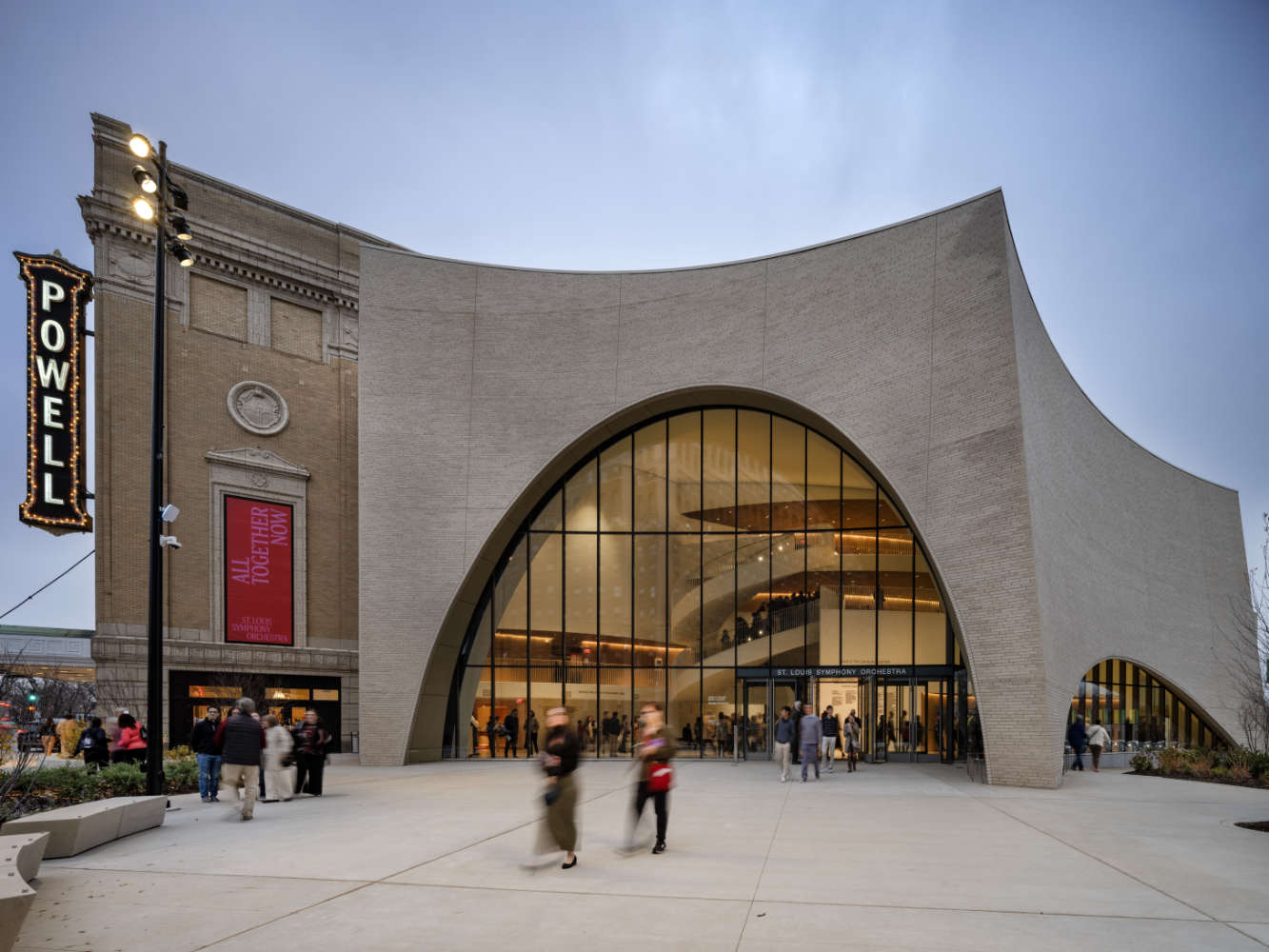
 With the start of the 2025–26 season, the St. Louis Symphony Orchestra has returned to its historic concert hall following a two-year transformational expansion and renovation. Powell Hall has served as the SLSO’s home since 1968, and the former vaudeville house and movie theater was added to the National Register of Historic Places in 2001.
The $140 million project created the Jack C. Taylor Music Center, with a renovated Powell Hall at its heart, transforming the 1925 building into a vibrant and accessible music center for the entire community. The first major renovation of the building since it became the SLSO’s permanent home in 1968, the project added 64,000 square feet to the venue and was designed by the New York City–based architecture firm Snøhetta.
“The St. Louis Symphony Orchestra musicians are beyond excited to return to our beloved home,” said Bjorn Ranheim, co-chair of the SLSO Musicians’ Council, our orchestra committee.
During the 2023–24 and 2024–25 seasons, the orchestra played at alternate venues throughout the St. Louis region, meeting new audiences as the orchestra traveled to different corners of the community.
Powell Hall at the Jack C. Taylor Music Center reopened for the first week of classical concerts September 26–28, 2025 with the world premiere of Kevin Puts’ new song cycle, House of Tomorrow, featuring mezzo-soprano Joyce DiDonato.
Visitors to the transformed venue will find a host of new amenities to make the concertgoing experience more comfortable. A new lobby adds gracious gathering space. More facilities—including restrooms, concession areas, and a coat check, among others—make the experience seamless.
And for the musicians, there’s a new, modern backstage area. Powell Hall was never built to accommodate an orchestra and previously lacked amenities for a modern orchestra.
“We were fortunate that the auditorium itself suited an orchestra so well, but our 100-year-old building has needed a touch up for a while,” said Will James, the SLSO’s Principal Percussionist.
The new backstage remedied these shortcomings. Musicians now enjoy a light-filled, spacious new lounge to unwind before or after rehearsals or concerts. A state-of-the-art music library space complements the reconfigured stacks in the depths of the Powell Hall basement, carefully preserving the SLSO’s vast sheet music collection. New men’s, women’s, and gender-neutral dressing rooms address a glaring inequity—Powell Hall previously didn’t have a women’s locker room. Twelve new practice spaces provide musicians convenient options to hone their craft. And climate-controlled instrument storage facilities have been vastly improved—especially for percussion, timpani, and pianos.
“The added practice and rehearsal spaces, coupled with a beautiful musicians’ lounge, make for a much more comfortable and productive environment, both pre- and post-concert,” said Chris Tantillo, SLSO Musicians’ Council co-chair, prior to the opening of the space.
These improvements will help attract the highest-caliber talent to St. Louis and retain them once here.
“We’ve always been fortunate to have the world-class acoustics of Powell Hall, and now we finally have backstage and front-of-house facilities to match! This is a very exciting time for our institution,” Double Bassist Brendan Fitzgerald said.
Along with the musician-forward services, the project positions the SLSO for greater flexibility in the future. New media suites make audio and video broadcasts easier and more efficient.
Preserving the signature sound
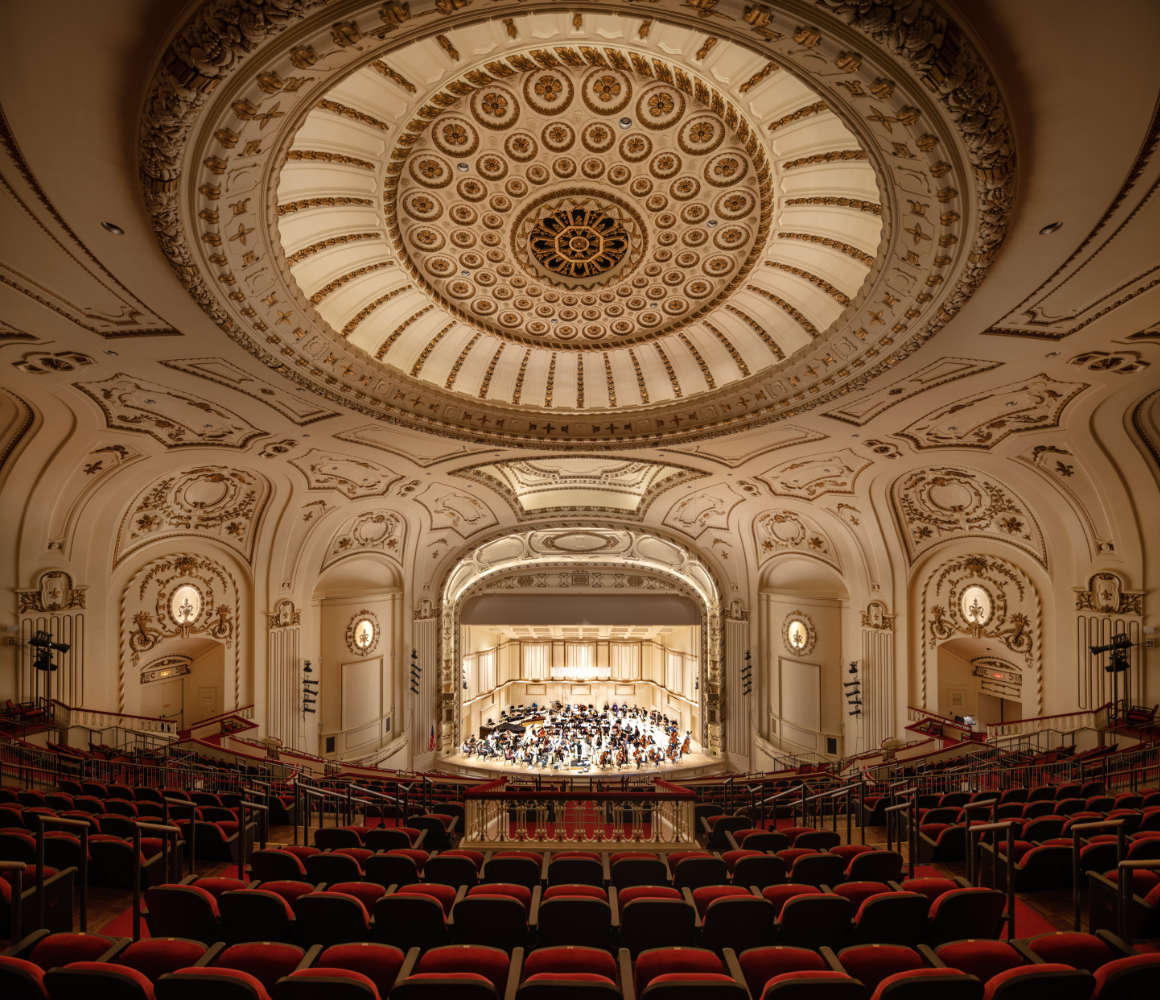 Powell Hall is one of America’s most acoustically remarkable and visually stunning concert halls. Countless musicians, both SLSO members and visiting artists, praise Powell Hall’s exceptional warmth of sound.
Stéphane Denève, the Joseph and Emily Rauh Pulitzer Music Director, describes the acoustic quality as “a beautifully melting sound.”
Adds Principal Violist Beth Guterman Chu: “The warmth and depth of sound at historic Powell Hall has helped to guide our orchestra into having a rich, deep, and complex sound. We are so excited that the new amenities, education wing, backstage, and front of house will now match the exquisite hall itself and create an even more welcoming and comfortable experience for everyone who walks into the building. While out of the hall, we have been so grateful for the generosity of our community to help us turn this dream into a reality, and we thank them for having been with us in different concert halls these last two years.”
Long before the first shovel overturned dirt on the project, Kirkegaard—the project’s acoustics firm—extensively studied and tested the acoustical qualities of Powell Hall, understanding its strengths and potential areas for improvement. Part of Kirkegaard’s studies included 3-D mapping of sound movement in the auditorium using “blasts” like popping balloons to chart the path of sound waves throughout the space.
Testing and interviews with musicians and staff revealed potential for improvement for the acoustics on the main floor. The acoustic model was used to confirm the proposed design solutions, which included adding low profile curved walls near the stage that will provide additional reflections from the stage to main floor audiences. The SLSO took great care in confirming the impact these new elements would have on the acoustics of the space. Kirkegaard and the project’s construction team created full-scale mockups of the shaped walls using lightweight and low-cost prototypes, which were lifted in and out of place during a special orchestra rehearsal, while musicians and staff listened carefully to the difference.
While architectural adaptations to the auditorium are the most visible way the acoustics have changed, Kirkegaard also recommended ways to reduce the intrusion of outside noise into the hall, including creating sound vestibules, reviewing materials and equipment selections for acoustical impact, and replacing old exit doors with acoustically rated ones.
Accessibility and safety
For those with accessibility needs, visiting the almost 100-year-old Powell Hall wasn’t so straightforward. With uneven surfaces, limited seating options, and a lack of amenities for people with a range of needs, barriers made a trip to the venue difficult or impossible for some. The renovation project addressed these issues and provides a more inclusive environment. Improving the accessibility of Powell Hall and making it more welcoming to all was a strategic cornerstone of the project.
Some of the improvements are obvious: adding three new elevators, increasing seating row depths, and adding many more accessible seating locations. Accessibility improvements also encompass the entire visitor experience. Patron parking and guest drop off is vastly improved through a new patron drop-off zone and a reconfigured parking lot with a new east-facing entrance closer to vehicles. Added handrails make the balcony more inclusive to seniors and people with neurological and sensory disabilities. The improvements continue in the back of house, where artist and staff amenities have been redesigned. All of these accommodations were designed to be as invisible as possible.
Centering education and learning
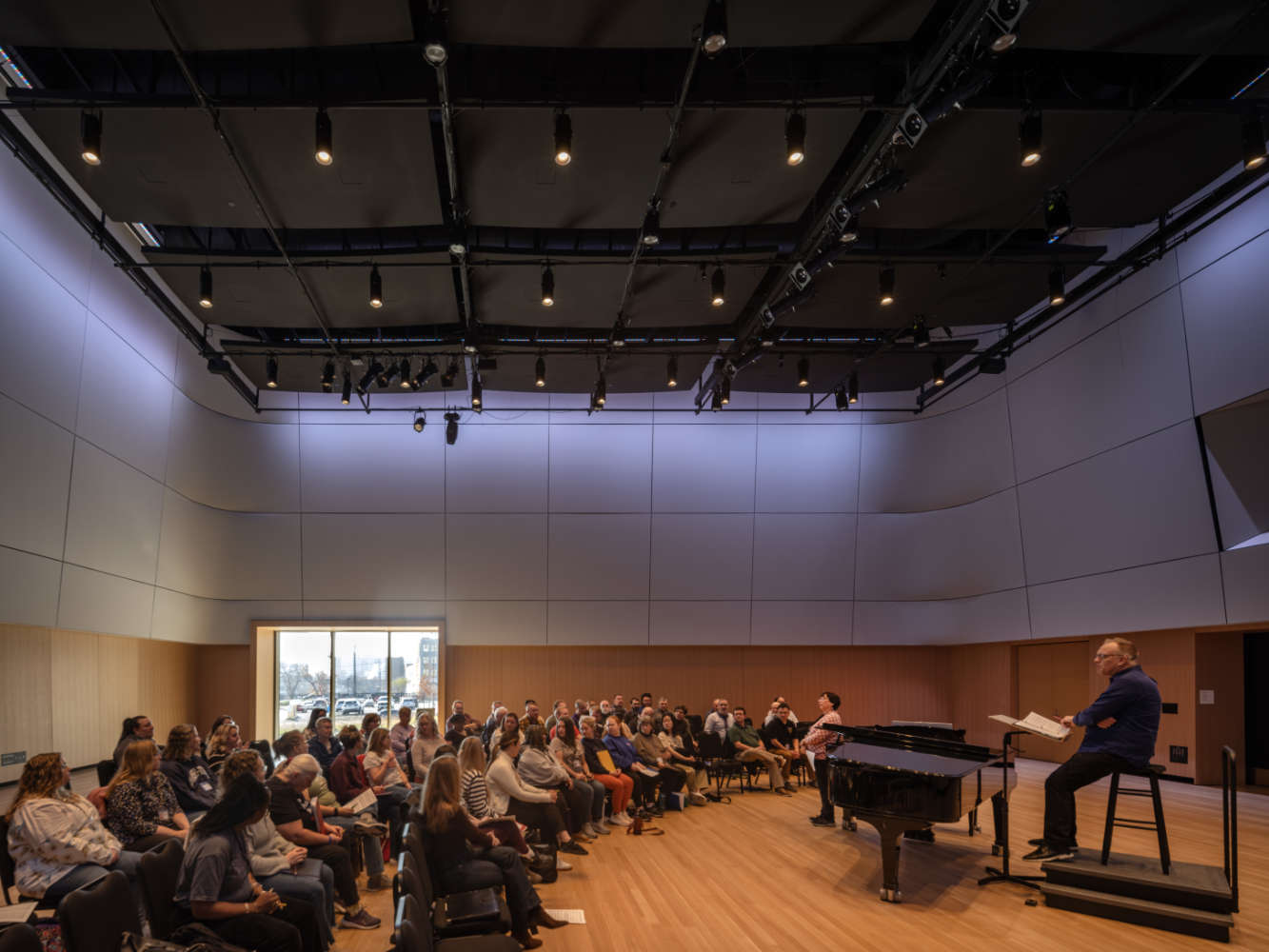 Another facet of the 64,000-square-foot expansion opens new doors that foster community connections through the power of music: a new Education and Learning Center (ELC) designed to unite the region’s residents as part of the SLSO’s vibrant community.
This nearly 4,000-square-foot space serves as a home for the SLSO’s education programs, a rehearsal space for the SLSO’s two resident choruses and the St. Louis Symphony Youth Orchestra, and a hub for events that brings the community together and explores creative collaborations. The SLSO collaborates with these ensembles throughout each season.
The state-of-the-art space supports music education programs and the teachers and students with whom the SLSO connects, more than 250,000 students around the world in the 2024–25 season alone. It can also act as rehearsal and creative laboratory for all SLSO ensembles, in addition to being an essential anchor for community engagement with our institution. Crafted to mimic the environment of Powell Hall, the floor consists of the same white oak as the concert stage.
Reopening
Construction began in March 2023 and was completed in September 2025, the 100th anniversary of the building’s opening. For much of the first year of construction, crews focused on creating infrastructure and laying the groundwork for the expansion. In summer 2025, new seats were installed in the auditorium and musicians gathered to play on the refurbished stage for the first time in two years.
Musicians and the community have welcomed the reopening of the storied venue. The 2025–26 season includes some of the world’s great artists for a festive season with some of the biggest and boldest pieces in the symphonic repertoire.
“This great venue has a unique character, and I always feel its beautiful soul while rehearsing or performing on stage. I am so excited by the renovation and expansion of our home,” Denève said.
The renovation and expansion of Powell Hall is part of decades-long urban development in St. Louis, which includes housing developments; hotels; schools; and visual, media, and performing arts facilities. Other significant projects in the community include the construction of a new stadium for the St. Louis CITY SC soccer team, the new National Geospatial-Intelligence Agency campus, the revitalization of the Gateway Arch and designation of Gateway Arch National Park, the Brickline Greenway, and more.
Snøhetta, the internationally acclaimed architecture firm, is the project lead and design architect. The firm’s portfolio includes the National September 11 Memorial & Museum, the San Francisco Museum of Modern Art, the Shanghai Grand Opera House, and the Norwegian National Opera and Ballet.
Crediting the community
Powell Hall holds a special place in the hearts of countless people in the community, as well as the orchestra’s musicians. A credit to the place of the SLSO in the community, the project has received outstanding support from many, who view the space as a nexus for community unity. That sentiment is shared by many SLSO musicians.
“As our individual instruments are our voices, Powell Hall is the instrument and voice of the SLSO,” said Jelena Dirks, the SLSO’s Principal Oboist. “I am so excited to be home and to be able to share that, becoming an even more welcoming and supportive focal point for the arts in St Louis.”
Cutting the ribbon to the new building in September 2025 ushered in a new chapter for the 145-year-old institution.
“I am so thrilled to be a part of this exciting time,” said Jennifer Nitchman, SLSO flutist. “The support of the community and our donors for this project bodes well for the future of the St. Louis Symphony Orchestra.”


